











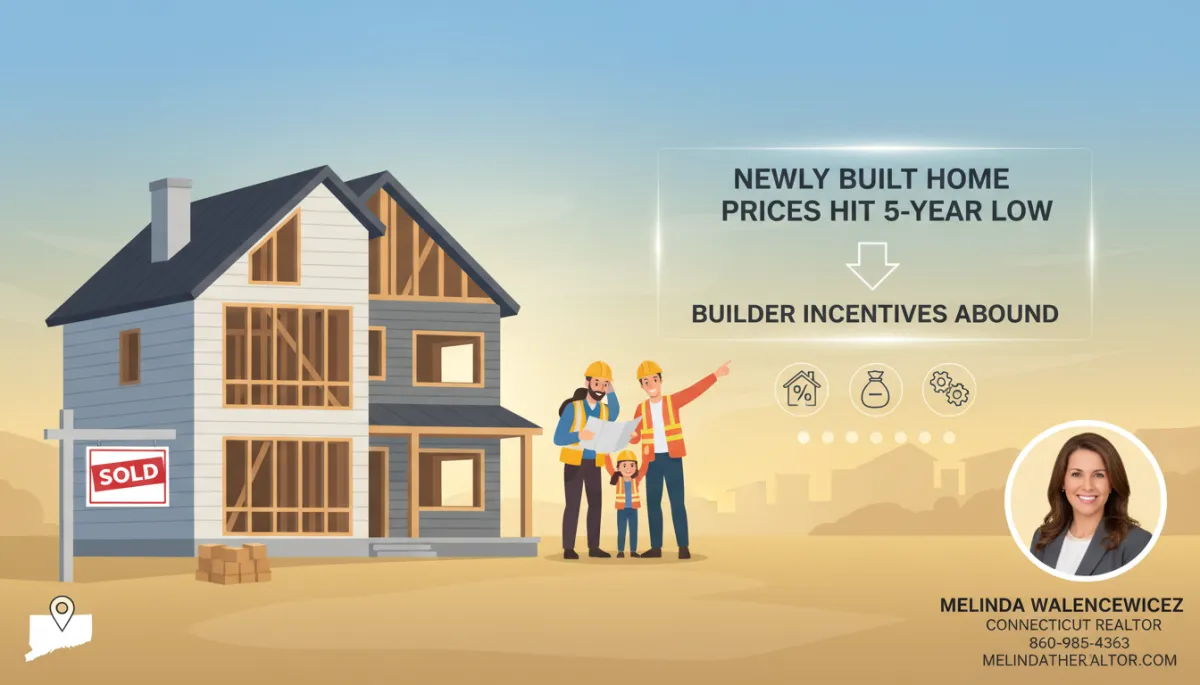
Newly Built Home Prices Hit 5-Year Low in 2026
Connecticut Real Estate, New Construction, Buyer Tips
Newly Built Home Prices Hit a 5 Year Low in 2026
If you’ve been sitting on the sidelines because you couldn’t find anything affordable in the resale market or kept getting outbid, there’s finally a shift worth paying attention to. Newly built home prices have dropped to their lowest point in five years nationally, and builders are rolling out incentives we haven’t seen in a long time. For Connecticut buyers, this could be the window you’ve been waiting for. Call me at 860-985-4363 or visit melindatherealtor.com for a free consultation. I’m never too busy for you to be my #1 client.
1. What’s Happening With New Home Prices Right Now
According to the latest data from the U.S. Census Bureau and HUD, the median sales price of new single-family homes in March 2026 was about $387,400. That’s down 6.2% from a year earlier and the lowest level since mid‑2021. Keeping Current Matters summed it up on May 21, 2026: newly built home prices have effectively hit a five‑year low, and that’s not an accident. It’s the result of builders adjusting to what buyers can actually afford in a higher‑rate world.
Over the last few years, builders ramped up production to try to catch up with demand. In some parts of the country, that extra supply is finally starting to show up in the numbers. At the same time, mortgage rates hovering in the mid‑6% range have made buyers more cost‑conscious. Instead of stretching for the absolute top of their budget, many buyers are saying, “This payment has to make sense every month, not just on paper.”
Builders are listening. To keep sales moving, they’re getting more creative than they’ve been in years. The result isn’t just a little discount around the edges. We’re seeing lower base prices and meaningful incentive packages layered on top. When you hear the phrase “newly built home prices 5 year low”, it’s not just a headline—it’s a signal that this part of the market has shifted in buyers’ favor for the first time in a long while.
2. What Builder Incentives Look Like Right Now
When you hear “builder incentives,” it can sound a little vague, so let’s break down what I’m actually seeing in 2026—both nationally and in conversations with builders here in Connecticut. These incentives vary by builder and community, but here are the big buckets you’ll run into:
- Mortgage Rate Buydowns. This is one of the most powerful tools on the table. Builders partner with preferred lenders to temporarily or permanently lower your interest rate. For example, if market rates are around 6.5% and the builder can get you to 5.75% on a $400,000 loan, that’s a payment difference of hundreds of dollars a month. Over the first few years, that can add up to thousands in savings and make your budget feel a lot more comfortable.
- Price Reductions. In some new communities around the country, we’re seeing base prices cut by $20,000–$50,000 or more compared to where they started. You may not see that same headline discount on every Connecticut neighborhood because our supply is tighter, but even a $10,000–$20,000 reduction can move a home from “nice but out of reach” to “we can actually do this.”
- Closing Cost Contributions. It’s increasingly common for builders to pay some or even all of your closing costs. That might look like $10,000–$20,000 toward lender fees, title, and prepaid items. For buyers who are tight on cash but solid on income, this can be the difference between waiting another year and getting the keys this summer or fall.
- Upgrade Credits. Instead of nickel‑and‑diming you for every finish, some builders will offer a design center credit—maybe $10,000–$30,000—to put toward things like countertops, flooring, appliances, or smart‑home features. It’s a way to get the home you really want without blowing past your budget on upgrades after you sign the contract.
The key thing to remember: all of this is negotiable. Incentives change month to month and even house to house, especially when a builder wants to hit a sales goal or move a completed “spec” home. That’s exactly where having an agent in your corner matters—I know what’s typical in our area, so I can push for the best possible package for you.
3. The New Construction Landscape in Connecticut
Now, let’s talk about how all of this translates to new construction Connecticut 2026, because our state doesn’t look like Texas or the Southeast. One big challenge here is zoning. Only about 2.2% of Connecticut’s land is zoned for multi‑unit housing, which really limits where and how much new housing can be built. That’s a big reason our overall inventory stays tight and prices keep creeping up.
According to recent housing market data, Connecticut has roughly 1.5–2 months of supply in many areas—Houzeo estimates around 1.46 months. A balanced market would be closer to six months, so you can see how far from “balanced” we really are. That means any new construction that does hit the market tends to attract serious interest quickly, especially if the pricing is even remotely competitive with resale homes.
The good news: we do have pockets of active building. Hartford County, Tolland County, New London County, and parts of eastern Connecticut are seeing more new communities and smaller infill projects. Some local builders are also taking advantage of state programs that encourage energy‑efficient and all‑electric homes, which can translate into lower long‑term utility costs for you as the buyer.
One insider tip: the best builder incentives Connecticut buyers see are often either at the very beginning of a community’s sales cycle—when the builder wants those first few contracts to get momentum—or on finished spec homes that are already built and costing the builder money every month they sit empty. If you’re flexible on exact floor plan or lot, those can be great opportunities.
4. Is New Construction Right for You?
New construction isn’t automatically better or worse than resale—it’s just different. The right choice really depends on your timeline, budget, and what you value most in a home. Let’s talk through both sides so you can gut‑check what fits you best.
When New Construction Can Be a Great Fit
- You love the idea of everything being brand new—roof, systems, appliances, the works—and not worrying about big repairs for a while.
- You’re okay with a longer timeline, often 6–12 months from contract to closing if you’re building from the ground up.
- You want to customize your layout and finishes instead of trying to “make it work” with what’s already there in an older home.
- You’re in an area with active new communities and can take full advantage of current builder incentives and energy‑efficient designs.
When New Construction May Not Be the Best Fit
- You need to move quickly—maybe because of a job change, lease ending, or school timing. In that case, a resale or a finished spec home might be more realistic than a to‑be‑built.
- You’re targeting a historic town center or older, established neighborhood where there simply isn’t much land left to build on.
- You love mature trees, older architecture, and the feel of a lived‑in neighborhood more than a brand‑new subdivision.
- In your specific price range and town, resale homes are offering clearly better overall value once you factor in taxes, HOA fees, and location.
Neither path is “wrong.” My job is to help you compare apples to apples so you can see what you’re really getting for your money in each scenario—and which one lines up with your life over the next five to ten years, not just the next five months.
5. Why You Still Need a Real Estate Agent for New Construction
One of the biggest myths I hear is, “It’s new construction, so I don’t really need an agent, right?” I get why it seems that way—the model home is beautiful, the sales rep is friendly, and everything feels very turnkey. But here’s the part most buyers don’t realize: the builder’s sales rep works for the builder, not for you. Their job is to protect the builder’s bottom line, not to negotiate every last dollar in your favor.
When I represent you on a new build, I’m there to:
- Negotiate the best combination of price and incentives, not just accept the first package offered.
- Flag contract terms that could create problems later—like timelines, change orders, or what happens if there are construction delays.
- Coordinate an independent home inspection (yes, you should still inspect a new home) and make sure punch‑list items are addressed before closing.
- Keep tabs on financing, appraisal, and construction milestones so you’re not the one chasing updates every week.
In most cases, the builder pays the buyer’s agent commission out of their marketing budget, so having me in your corner usually costs you nothing out of pocket. You’re already paying for representation—my view is, you should actually get it. If you’re even thinking about visiting a model home, call or text me first at 860‑985‑4363 so we can make sure your interests are protected from day one.
FAQ: New Construction in Connecticut, Answered
1. Are new home prices really lower right now?
Nationally, yes—median new home prices are down compared to the last few years, hitting their lowest point since 2021. In Connecticut, because supply is so limited, you may not see dramatic sticker‑price drops in every town. But when you layer in builder incentives, rate buydowns, and closing cost help, the effective cost of buying new can be lower than it was a year or two ago, even if the list price doesn’t look drastically different.
2. Do I really need an agent for new construction?
I’d strongly recommend it. The builder has professionals representing them—you deserve the same. From negotiating incentives to reviewing the contract and coordinating inspections, there are a lot of moving pieces. Having an experienced local agent in your corner usually doesn’t cost you extra, and it can save you money, stress, and surprises down the road.
3. Are there actually new construction homes available in Connecticut?
Yes—just not everywhere and not in huge numbers. You’ll find more options in parts of Hartford, Tolland, New London, and eastern Connecticut than in dense historic town centers where land is scarce. Because we’re working with around a month and a half of total housing supply statewide, new builds that are priced well tend to move quickly. If you tell me your budget and preferred towns, I can show you what’s currently available and what’s coming soon.
4. What is a mortgage rate buydown and how does it help?
A mortgage rate buydown is when someone—often the builder—pays money up front to lower your interest rate for a set period or for the life of the loan. For example, dropping your rate from 6.5% to 5.75% on a $400,000 mortgage can cut your monthly payment by hundreds of dollars. That can make it easier to qualify and more comfortable to live with long‑term. It’s one of the most impactful builder incentives Connecticut buyers are seeing in 2026.
5. How long does it take to buy a newly built home in Connecticut?
It depends on whether you’re buying a home that’s already under construction or building from scratch. For a finished or nearly finished spec home, you might close in 30–60 days—similar to a resale. For a to‑be‑built home where you’re picking the lot and floor plan, plan on roughly 6–12 months from contract to move‑in, depending on the builder’s schedule, weather, and permitting. We’ll talk about your timeline up front so we only look at options that actually work for your life.
Ready to Explore New Construction in Connecticut?
If you’ve been frustrated by bidding wars or tired of watching homes sell before you can even schedule a showing, it might be time to look at new construction with fresh eyes. With newly built home prices at a five‑year low nationally and builders offering some of the strongest incentives we’ve seen in years, 2026 is a smart time to at least run the numbers and see what’s possible for you here in Connecticut.
Call me at 860‑985‑4363 or visit melindatherealtor.com to schedule your free consultation. We’ll walk through your budget, your ideal towns, and whether new construction, resale, or a mix of both makes the most sense. I’m never too busy for you to be my #1 client.
Sources
- Keeping Current Matters, “Newly Built Home Prices Hit a 5‑Year Low,” May 21, 2026 – keepingcurrentmatters.com/2026/05/21/newly-built-home-prices-hit-a-5-year-low
- U.S. Census Bureau and HUD New Residential Sales – census.gov/construction/nrs
- Houzeo Connecticut Housing Market Data – houzeo.com/housing-market/connecticut
- Innago Connecticut Housing Market Trends & Forecast – innago.com/connecticut-housing-market-trends-forecast
- National Association of REALTORS® – nar.realtor