












Is the CT Housing Market Actually 'Crashing'?
If you have spent any time on social media or watching the news lately, you have probably seen the headlines. There is a lot of "doom and gloom" talk about a massive real estate bubble. People are asking the same question over and over: Is the Connecticut housing market actually crashing?
It is easy to get caught up in the noise, especially when you are thinking about selling your home. You want to make sure you are not listing your property right before a cliff. As we move into April 2026, I want to set the record straight. While the market is certainly changing, the data tells a much different story than the "crash" rumors suggest. In fact, if you are a homeowner in towns like Woodstock or Putnam, you are actually sitting in a very strong position.
Let’s dive into what is really happening in the Connecticut real estate market right now and why the "slow squeeze" is actually working in your favor.
The Myth of the 2026 Market Crash
The word "crash" gets thrown around because it grabs attention. However, a true market crash requires a few specific ingredients: a massive oversupply of homes, high unemployment, and predatory lending practices. None of those factors are present in our current Connecticut market.
According to recent market data, Connecticut’s average home value reached approximately $425,784 by late 2025, which was a 3.8% increase over the previous year (Zillow, 2025). Rather than prices falling, we are seeing stable, moderate growth. In high demand areas like Fairfield County, the median sale price even hit $662,500, marking an 8.6% year-over-year jump (Redfin, 2025).
When prices continue to climb even with higher interest rates, it is a sign of a resilient market, not a collapsing one. The "bubble" people are worried about usually bursts when demand disappears, but in Connecticut, buyers are still lining up for well-maintained homes.
The "Slow Squeeze" and Low Inventory
If you want to understand why prices are staying high, you have to look at inventory. This is what experts call the "slow squeeze." We simply do not have enough houses for sale to meet the number of people who want to buy them.
Inventory levels remain significantly lower than they were before the pandemic. For context, some parts of Connecticut have seen a 65% decrease in available housing supply compared to 2019 levels (NAR, 2025). When there are 3,600 fewer homes on the market than there were a few years ago, the competition among buyers remains fierce.

This scarcity creates a massive advantage for you as a seller. When inventory is tight, you have more leverage. You are more likely to see multiple offer situations, fewer requests for contingencies, and sales prices that meet or exceed your asking price. Even in smaller communities like Scotland or Sterling, the lack of competition from other sellers means your home stands out more than ever.
Why Buyer Demand is Still High
You might be wondering, "With mortgage rates still in the 6% range, who is actually buying?" It is a fair question. While higher rates have sidelined some buyers, the overall demand in Connecticut remains surprisingly robust.
Home sales actually increased by about 4.5% in several regions over the last year despite those interest rates (Realtor.com, 2025). Many buyers have realized that the "new normal" for rates is here to stay for a while, and they are tired of waiting on the sidelines. Additionally, Connecticut remains a top destination for people relocating from higher-priced metropolitan areas who are looking for more space and a better quality of life in towns like Pomfret and Eastford.

The current pool of buyers is also financially stable. Unlike the 2008 crisis, today’s buyers are well-qualified with solid credit scores and significant down payments. This stability in the mortgage market is one of the biggest reasons a crash is not on the horizon.
Maximizing Your Sale in a Tight Market
Just because it is a seller's market doesn't mean you should just "wing it." To get the best possible return on your investment, you need a strategy that targets the right buyers and highlights your home's best features.
One of the best ways to increase your home value before listing is to focus on high-ROI improvements. Even in a low inventory market, buyers are looking for homes that feel move-in ready.
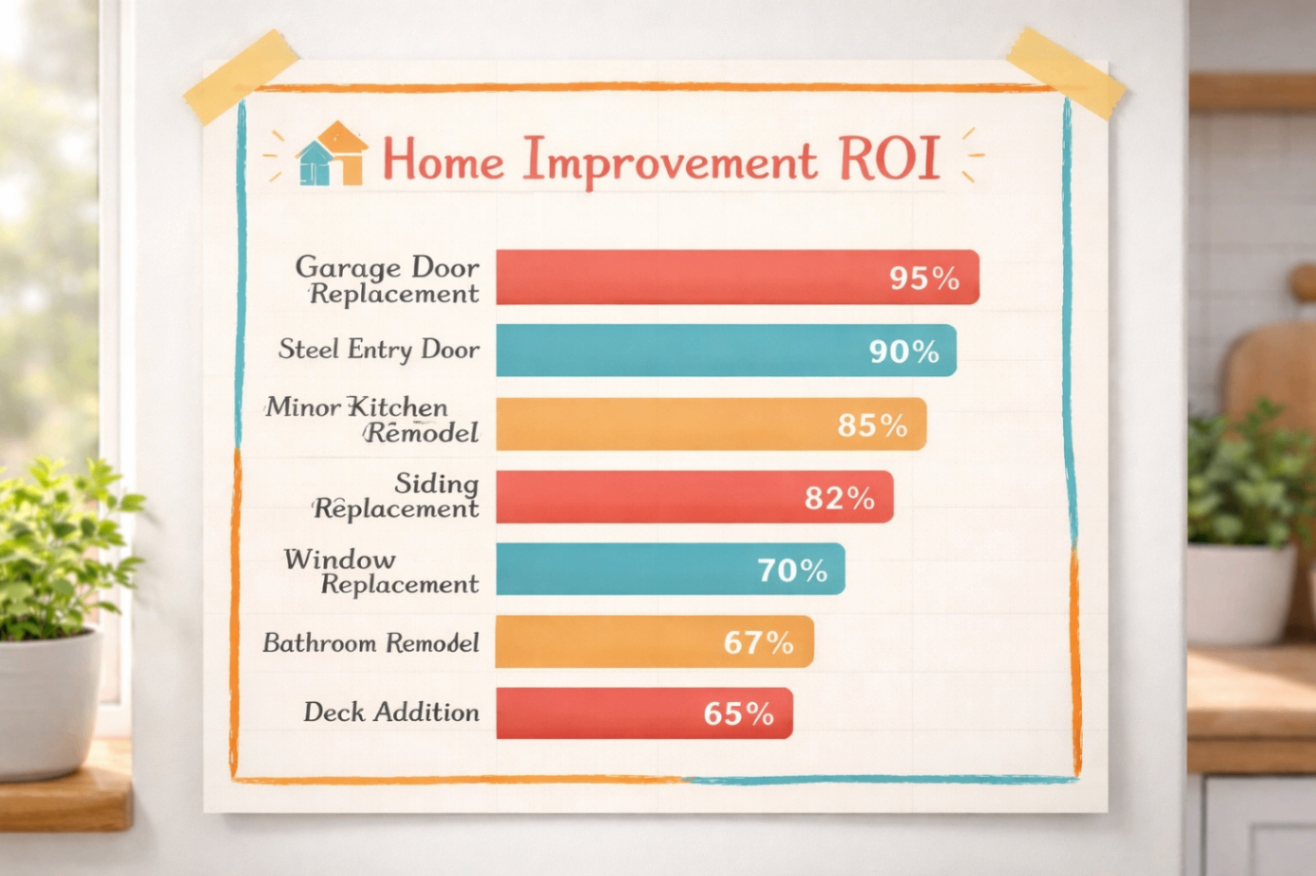
As the chart shows, things like minor kitchen remodels and siding replacements offer great returns. However, if you are looking for a quick win, even simple tasks like decluttering and improving curb appeal can make a world of difference. When I work with sellers in Killingly or Plainfield, we focus on the specific upgrades that local buyers are looking for right now.
The Importance of Local Expertise
Real estate is always local. What is happening in a national headline might not apply to your neighborhood in Tolland or Vernon. This is where having an experienced agent makes all the difference.
I spend my days tracking the subtle shifts in the Connecticut market. I look at the "days on market" for specific zip codes, the sale-to-list price ratios, and the feedback from buyers at open houses. This ground-level data allows us to price your home accurately: not too low that you leave money on the table, and not so high that your listing becomes "stale."
Navigating these conditions requires a steady hand. Whether you are selling a family home in Brooklyn or a quiet retreat in Ashford, my goal is to make sure you feel confident and informed every step of the way.
Frequently Asked Questions
Is now a good time to sell my house in Connecticut?
Yes. Because inventory is so low, sellers currently have a significant advantage. High demand and limited competition often lead to faster sales and stronger offers.
What happens if interest rates go up further?
While higher rates can slow down some buyers, the extreme lack of inventory in Connecticut acts as a safety net for home prices. As long as there are more buyers than homes, prices tend to remain stable.
Should I lower my price if I don't get an offer in the first week?
Not necessarily. In today's market, "days on market" is still relatively low: around 11 days on average (Zillow, 2025). If your home is priced correctly and marketed well, you should see activity quickly. If not, we look at the feedback and adjust based on real data, not panic.
How do I know what my home is worth in this market?
Online estimators are a starting point, but they often miss the nuances of your specific street or the recent upgrades you have made. A professional comparative market analysis is the only way to get an accurate picture.
The Bottom Line
The Connecticut housing market is not crashing; it is evolving. We are in a period of "stable growth" fueled by a "slow squeeze" of inventory. For homeowners, this is actually one of the most opportune times to sell that we have seen in years. The key is to ignore the national noise and focus on the local facts.
If you are curious about what your home could sell for in today's market, I am here to help. We can look at the data together and come up with a plan that works for your timeline and your goals.
Call me at 860-985-4363 or visit melindatherealtor.com for a free consultation. Never too busy for you to be my #1 client.
Sources
Zillow. (2025). Connecticut Home Values and Market Trends.
Redfin. (2025). Fairfield County Real Estate Market Report.
National Association of Realtors (NAR). (2025). Housing Shortage and Inventory Analysis.
Realtor.com. (2025). Northeast Regional Housing Demand Forecast.