











CT Home Affordability: Why 2026 is Looking Up
There's finally some good news for Connecticut buyers who've been sitting on the sidelines: buying a home is getting more affordable.
Monthly mortgage payments have started to come down, and the financial squeeze that's made homeownership feel impossible for so many is slowly loosening. Now, that doesn't mean everyone can suddenly afford a home, but after years of watching the market get harder and harder to break into, the improvement we're seeing actually matters.
Understanding the Affordability Threshold
One of the best ways to measure whether homes are truly affordable is by looking at how much of your monthly income goes toward housing costs.
According to Zillow, housing is generally considered affordable when it takes 30% or less of your household income to cover your expenses: that includes your mortgage payment, property taxes, homeowner's insurance, and basic maintenance.[1]
For the past few years, the math was well above that threshold. In many Connecticut markets, buyers were spending 35% or more of their income just to get into a home. That made homeownership unachievable for many families, especially first-time buyers trying to compete in a market where prices kept climbing and mortgage rates stayed stubbornly high.
But here's the shift: we're slowly moving back toward balance. Recent data from Zillow shows it's taking less of a typical household's income to buy a home than it did just a couple of years ago.[1] We're not all the way back to that 30% sweet spot yet, so affordability is still tight: but things are trending in the right direction.

Three Big Factors Driving Affordability in Connecticut
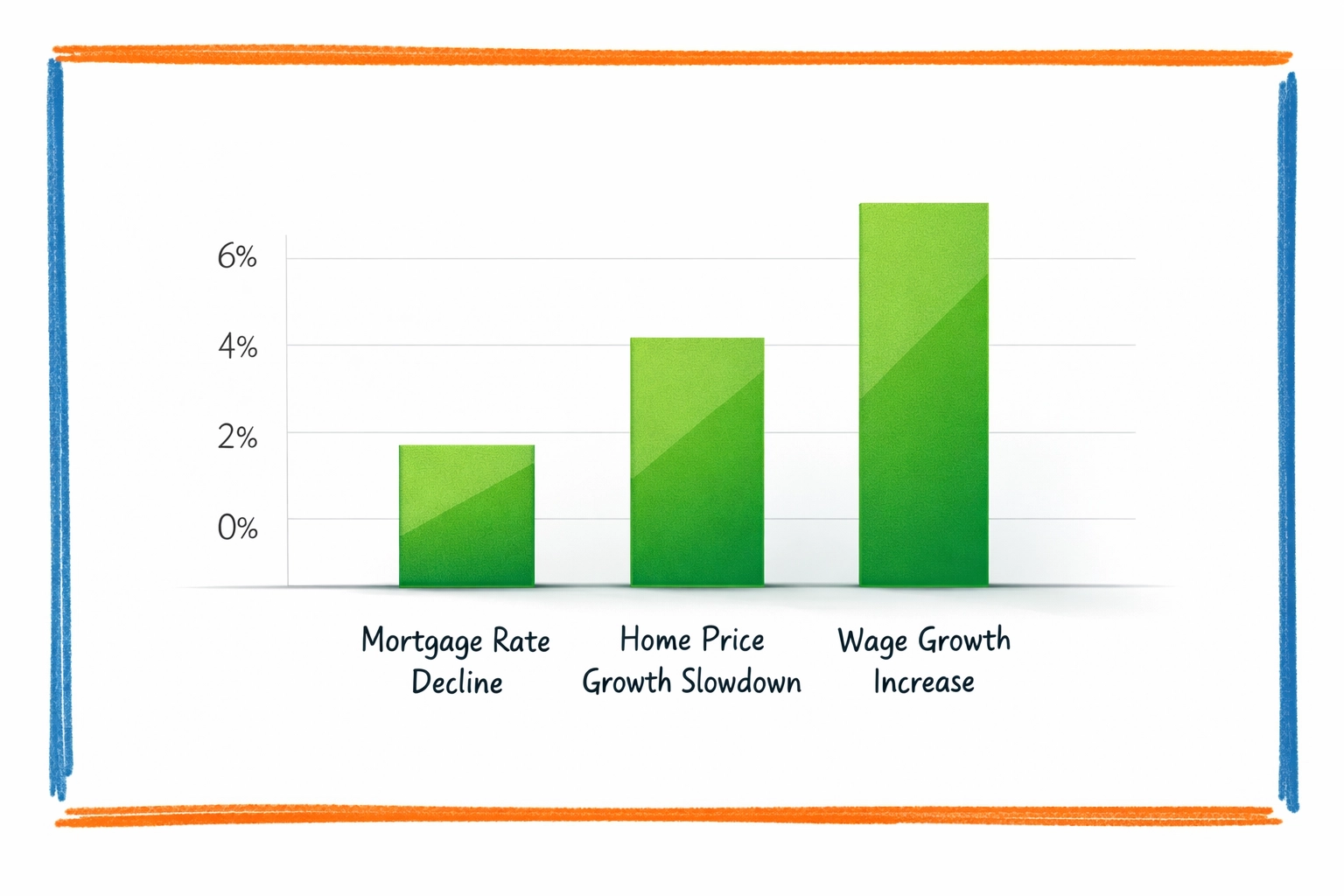
So what's actually changing? A lot of attention has focused on mortgage rates dropping over the past year, and that's definitely part of the story. But it's not the only factor working in favor of buyers right now. There are three big trends improving the affordability picture in 2026:
1. Mortgage Rates Have Eased
Mortgage rates are near their lowest level in more than three years. According to Freddie Mac, rates are forecast to average around 6.3% throughout 2026: down from the 7%+ range we saw in late 2023 and early 2024.[2]
That might not sound like a huge drop, but even a half-point decrease can lower your monthly payment by hundreds of dollars over the life of a 30-year loan. For Connecticut buyers, where the median home price hovers around $400,000, a rate of 6.3% versus 7.0% could mean saving $150 to $200 per month. That adds up quickly and makes qualifying for a loan more realistic for households on tighter budgets.
2. Home Price Growth Has Cooled
Prices aren't falling nationally, but they're growing much more slowly than they were a few years ago. In Connecticut specifically, Hartford area home values are projected to appreciate by about 3.9% in 2026: a far cry from the double-digit spikes we saw in 2021 and 2022.[3]
That slower growth means buyers today aren't facing the same sharp jumps in purchase prices. If you're shopping for a home, you can actually plan and budget without worrying that the house you want today will be $30,000 more expensive in three months. Buying becomes more predictable, and that predictability helps keep monthly payments manageable.
3. Wage Growth Is Exceeding Price Growth
This one matters a lot, and it doesn't get talked about nearly enough. For the first time in several years, wages are growing faster than home prices. That shift is improving what economists call "house-buying power."
Mark Fleming, Chief Economist at First American, explains it perfectly:
> "When income growth exceeds house price growth, house-buying power improves: even if mortgage rates don't decline meaningfully."[4]
In practical terms, that means your paycheck is stretching further. Even if mortgage rates stay elevated compared to historic lows, you're earning more relative to what homes cost: and that tips the affordability scale back in your favor.
Fleming goes on to say:
> "Affordability remains challenging, but for the first time in several years, the underlying forces are finally aligned toward gradual improvement. Mortgage rates may drift down only slowly, but income growth exceeding house price appreciation will provide a boost to house-buying power: even in a higher-rate world. Affordability won't snap back overnight, but like a ship finally catching a steady tailwind, it's now sailing in the right direction."[4]
What This Means for Connecticut Buyers
National trends are great, but what really matters is what's happening in your local market: and here in Connecticut, we're seeing some real momentum.
Realtor.com projects that in many markets across the country, the typical monthly mortgage payment will fall enough to dip below the 30% of income threshold by the end of 2026: the first time that's happened since 2022.[1] While Hartford buyers should still expect to allocate around 33.6% of their income toward housing costs, that's an improvement over where we were just a year ago.[3]
Beyond the numbers, the market itself feels different. Bidding wars have become less common. Homes aren't flying off the market in 48 hours with 10 competing offers. Only 16.5% of Hartford homes are receiving price cuts right now, which signals more normalized, stable conditions.[3]
That stability is huge for buyers who've felt overwhelmed by the chaos of the past few years. You have time to think, to tour homes more than once, to negotiate: things that weren't possible when the market was red-hot.
Two Policy Changes Helping Connecticut Buyers
There are also two specific policy shifts in 2026 that are easing the financial burden for homebuyers:
PMI Tax Deduction Reinstatement: Private mortgage insurance (PMI) premiums are once again tax-deductible on federal returns. If you're buying a Connecticut home at $400,000 with 10% down, your PMI costs of $150 to $250 per month become deductible, reducing your overall housing expenses.[5]
Fannie Mae's Extended Buyer Credit: This additional assistance helps more buyers qualify for loans and effectively reduces borrowing costs, making homeownership accessible to households who might have been just on the edge of qualifying.[5]
These aren't game-changers on their own, but combined with improving market conditions, they remove friction from the buying process.

Why Local Expertise Still Matters
Here's the thing: national data tells part of the story, but every Connecticut town has its own micro-market. What's happening in New Haven might look totally different from what's happening in Mystic or Danbury. Inventory remains about 60% below pre-pandemic levels in many areas, which continues to put upward pressure on prices even as growth slows.[3]
That's where working with a local agent who knows your specific area makes all the difference. I can show you exactly how affordability is shifting in the neighborhoods you're interested in, what kind of competition you'll face, and how to structure an offer that works within your budget without overpaying.
I also use AI-driven home shopping tools that give you custom insights based on your specific financial situation. Instead of just browsing listings and hoping for the best, you can see real-time data on what you can actually afford, how different interest rates impact your buying power, and which homes fit your lifestyle and budget. It takes the guesswork out of the process and gives you confidence in your decisions.
Ready to See How the Numbers Work for You?
Affordability is improving, but the window won't stay open forever. As more buyers realize conditions are getting better, competition will pick back up: especially in desirable Connecticut neighborhoods where inventory is already limited.
If you've been waiting for the right time, this might be it.
Call me at 860-985-4363 or visit melindatherealtor.com for a free consultation. Never too busy for you to be my #1 client.
Frequently Asked Questions
What does "30% of income" really mean when buying a home?
The 30% rule means your total monthly housing costs: including your mortgage payment, property taxes, homeowner's insurance, HOA fees (if applicable), and maintenance: should not exceed 30% of your gross monthly household income. This is considered the threshold for affordable housing and helps ensure you're not "house poor."
Are mortgage rates expected to keep falling in 2026?
Mortgage rates are forecast to average around 6.3% in 2026, which is slightly lower than 2025 but still elevated compared to the 3% rates we saw in 2020-2021. Rates may drift down slowly, but dramatic drops aren't expected. The good news is that even modest rate decreases combined with wage growth are improving affordability.
What if I can't put 20% down on a Connecticut home?
You don't have to put 20% down. Many conventional loans allow as little as 3% to 5% down, and FHA loans require only 3.5%. You'll pay PMI (private mortgage insurance) if you put down less than 20%, but the good news is PMI premiums are now tax-deductible in 2026, reducing that extra cost.
Is it better to wait until rates drop more, or buy now?
Waiting for rates to drop might seem smart, but remember: when rates fall, competition increases and home prices tend to rise. You could end up paying more for the home itself, which offsets any savings from a lower rate. Plus, you can always refinance later if rates drop significantly, but you can't go back and buy yesterday's lower-priced home.
How much home can I afford in Connecticut right now?
It depends on your income, debts, down payment, and the interest rate you qualify for. As a rough guideline, lenders typically want your total monthly debt payments (including your mortgage) to be no more than 43% of your gross income. But the best way to know is to get pre-approved and use tools that calculate your buying power based on current rates and your specific finances.
What's the inventory situation like in Connecticut?
Inventory is still about 60% below pre-pandemic levels in many Connecticut markets, which keeps upward pressure on prices. However, competition has eased compared to 2021-2022, and you're more likely to have time to think and negotiate rather than rushing into bidding wars.
Sources
Zillow – Housing Affordability Trends & 30% Income Threshold Data
https://www.zillow.com/research
Provides national and regional data on how much income households are spending on housing and how affordability is improving.Freddie Mac – 2026 Mortgage Rate Forecasts
https://www.freddiemac.com/pmms
Official outlook on mortgage rate trends, showing the projected easing of rates into the low-6% range.Realtor.com – Hartford & Connecticut Housing Market Projections
https://www.realtor.com/research
Local market data on price growth, inventory levels, and monthly payment trends specific to Connecticut.First American – House-Buying Power Index & Affordability Analysis
https://www.firstam.com/economics
Economic research explaining how wage growth vs. price growth affects real buying power.National Association of Realtors – PMI Deduction & Buyer Assistance Updates
https://www.nar.realtor
Details on policy changes like the PMI tax deduction and other affordability programs affecting buyers in 2026.