











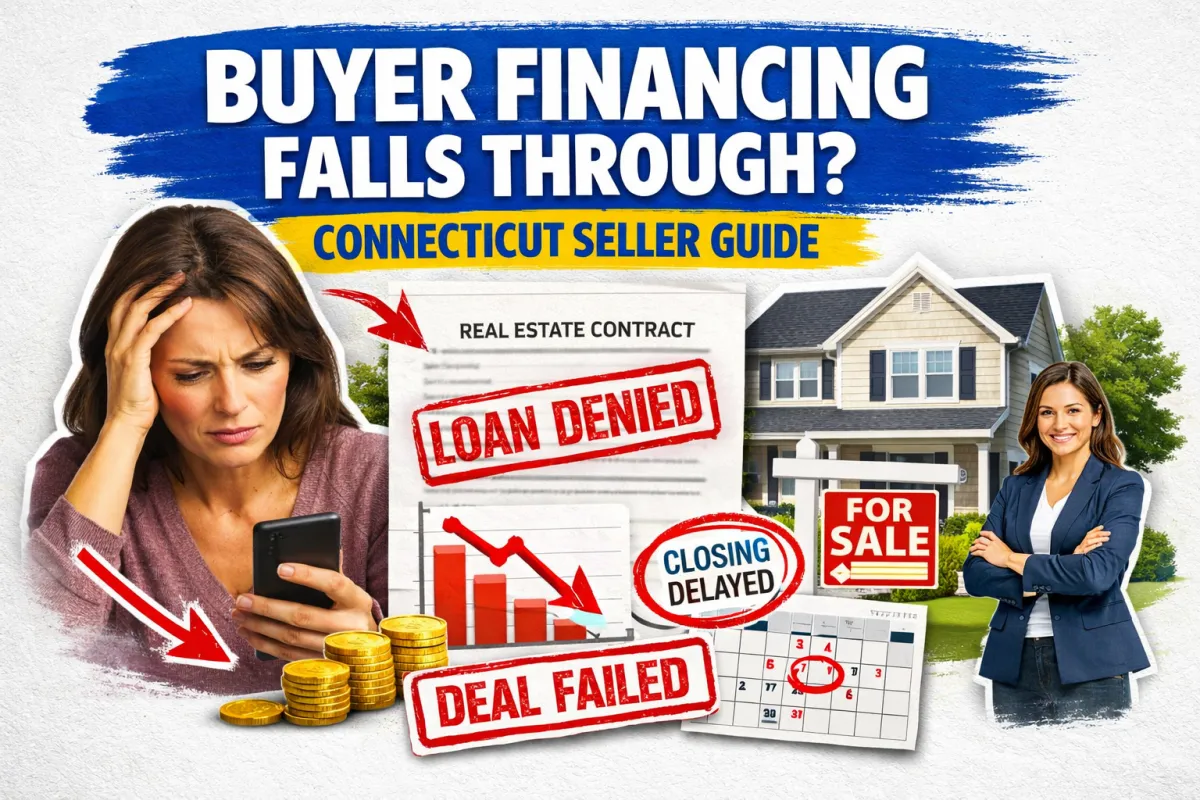
Buyer Financing Falls Through in Connecticut Sellers
What Happens When a Buyer’s Financing Falls Through in Connecticut?
When a buyer’s financing falls through in Connecticut, sellers are often left wondering what happens next and how much time they’ve lost. Here’s the surprising truth, nearly 1 in 10 home contracts fall through before closing, and financing issues are one of the top reasons.
If you’re selling in Tolland, Windham, Hartford, New London, or Middlesex County, this situation can feel stressful, especially if you’re trying to time your next move. The good news is, you usually have more control than you think.
In this guide, I’ll walk you through exactly what happens, what your options are, and how to recover quickly without losing momentum.
Hi, I’m Melinda, an AI-Certified Realtor® serving Connecticut communities. I combine local market knowledge with smart technology and real human support to help sellers navigate situations like this calmly and strategically. 😊

What Causes Buyer Financing to Fall Through in Connecticut?
Short answer: Financing typically falls through due to loan denial, appraisal issues, or last-minute financial changes by the buyer.
Even when a buyer is pre-approved, things can still go wrong. Common causes include:
Job loss or income changes
New debt before closing
Low appraisal
Lender underwriting issues
According to the National Association of Realtors, financing problems remain one of the most common reasons transactions fail https://www.nar.realtor
💡 Key takeaway: Pre-approval is not a guarantee, underwriting is where deals are truly tested.
What Happens to the Seller When Financing Falls Through?
Short answer: In most cases, the contract is terminated legally, and the home goes back on the market unless backup options exist.
If your contract includes a financing contingency, the buyer can usually exit without penalty if their loan is denied. That means:
You may not keep the deposit
Your home returns to active status
You restart negotiations with new buyers
Connecticut contracts are designed to protect both parties, which is why contingencies matter.
According to Connecticut Department of Consumer Protection, real estate contracts must clearly outline contingency terms https://portal.ct.gov/DCP
Do You Have to Start Over Completely?
Short answer: Not always, many sellers can recover quickly using backup offers or re-engaging interested buyers.
Here’s where strategy matters:
Did you have backup offers?
Were there other interested buyers during showings?
Is your listing still fresh in the market?
In many Connecticut markets, especially Hartford and Middlesex Counties, demand can still support a quick rebound if handled correctly.
💡 Smart move: Reach out immediately to previous interested buyers before relisting fully.
How Does This Affect Your Timeline and Next Move?
Short answer: A failed deal can delay your timeline, but it does not necessarily mean starting from zero.
This is where most sellers feel the pressure. You might be:
Planning to buy another home
Relocating for work
Worried about missing the “right” market window
According to Zillow, timing concerns often lead sellers to make emotional decisions after a failed contract https://www.zillow.com/sellers-guide
💡 Reality check: The market rarely shifts overnight. A calm reset usually beats a rushed decision.
Should You Relist Immediately or Wait?
Short answer: Most sellers benefit from relisting quickly, but with adjustments based on feedback.
Before jumping back in, ask:
Was pricing aligned with the market?
Were there concerns from the appraisal?
Did buyers hesitate for specific reasons?
In areas like Windham and New London Counties, buyer sensitivity to pricing and financing has increased slightly, making positioning more important than ever.
According to Realtor.com, properly repositioned listings often sell faster after relisting https://www.realtor.com/advice/sell

How Are Connecticut Sellers Handling This Right Now?
Short answer: Sellers in Connecticut are focusing more on buyer quality and flexibility rather than just price.
Locally, I’m seeing:
More attention to buyer pre-qualification strength
Increased use of backup offers
Strategic pricing adjustments instead of large reductions
In Tolland and Hartford Counties especially, well-prepared listings are still moving, even after a failed deal.
💡 Local insight: The second buyer is often stronger than the first when handled correctly.
How Can You Protect Yourself From This Happening Again?
Short answer: Stronger buyer vetting and smarter contract strategies reduce the risk significantly.
Here’s what works:
Ask for lender verification, not just pre-approval
Evaluate buyer financial stability
Consider backup offers
Work with an agent who screens thoroughly
According to Bankrate, sellers who prioritize financially strong buyers reduce fall-through risk significantly https://www.bankrate.com/real-estate
Is There a Hidden Opportunity After a Failed Deal?
Short answer: Yes, many sellers end up with better offers after a deal falls through.
Why?
Your home gains more exposure
Serious buyers step forward
Pricing and strategy improve
Sometimes, the first deal sets the stage, but the second deal closes stronger.
💡 Mindset shift: This is not failure, it is repositioning.

AI-Certified Advantage: How I Help Sellers Navigate This
As an AI-Certified Realtor®, I use smart tools to:
Identify high-quality buyers faster
Analyze pricing precision in your exact neighborhood
Track buyer behavior and intent
Adjust strategy in real time
For you, that means:
Less guesswork
Faster recovery after setbacks
Better chances of stronger offers
It’s not about replacing the human touch, it’s about enhancing it so you feel confident every step of the way. 😊
Conclusion
A buyer’s financing falling through can feel like a setback, but it does not have to derail your entire plan. With the right strategy, many sellers recover quickly and even come out ahead.
The key is staying calm, making informed decisions, and working with someone who understands both the market and the moment you’re in.
Call me at 860-985-4363 or visit melindatherealtor.com for a free consultation. Never too busy for you to be my #1 client.
FAQ Section
Q: Can I keep the buyer’s deposit if financing falls through in Connecticut?
A: Usually no, if the contract includes a financing contingency, the buyer is typically entitled to their deposit back if their loan is denied. However, each contract is different, so reviewing terms carefully is important.
Q: How common is it for home sales to fall through due to financing?
A: It happens more often than people expect. Financing issues are one of the top reasons deals fail, especially during changing market conditions or stricter lending requirements.
Q: How fast can I relist my home after a deal falls through?
A: In most cases, you can relist immediately once the contract is officially terminated. Many sellers in Connecticut go back on the market within 24 to 48 hours.
Q: Should I accept backup offers as a seller?
A: Yes, backup offers can provide a safety net. If the first deal falls through, you can move forward quickly without starting from scratch.
Q: Will my home look bad if it goes back on the market?
A: Not necessarily. With proper positioning and explanation, many buyers understand that financing issues are common and not a reflection of the property itself.
Sources
National Association of Realtors (NAR) – Appraisal & Market Data
https://www.nar.realtor/research-and-statistics
Supports appraisal gap trends and competitive market dynamics.Connecticut Department of Consumer Protection – Real Estate Regulations
https://portal.ct.gov/DCP/Real-Estate
Covers contingency protections, licensing, and buyer rights in CT transactions.Consumer Financial Protection Bureau (CFPB) – Appraisal Process
https://www.consumerfinance.gov/owning-a-home/
Explains how appraisals affect loans, LTV, and financing decisions.Zillow Research – Appraisal & Pricing Trends
https://www.zillow.com/research/
Data on renegotiation behavior and pricing vs appraised value.Realtor.com – Appraisal Gap & Buyer Strategy Insights
https://www.realtor.com/advice/
Guidance on appraisal gaps, buyer decision-making, and market strategy.Custom HTML/CSS/JAVASCRIPT